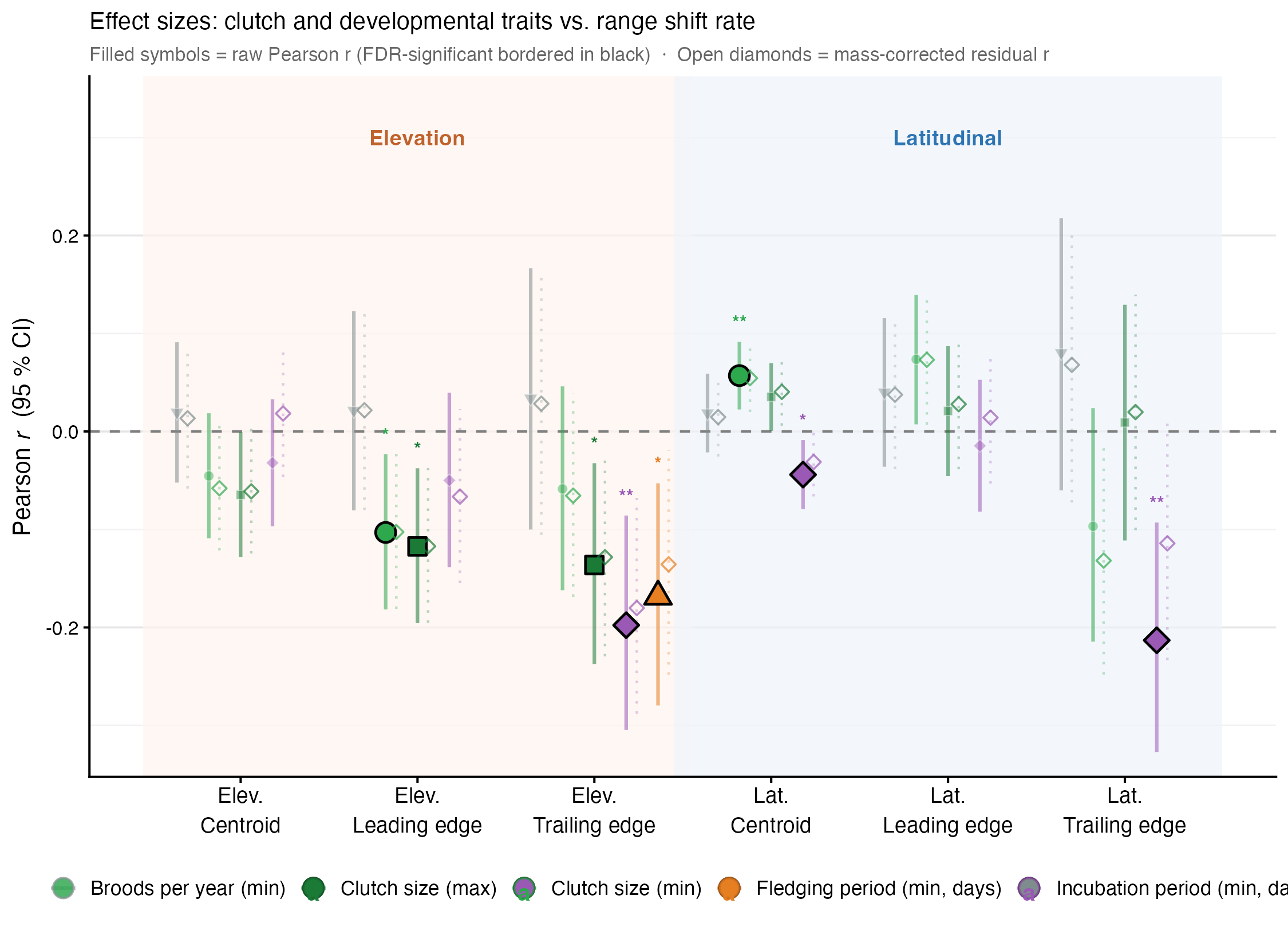
As climate change pushes thermal envelopes poleward and upslope, species’ life-history pace is expected to shape their capacity to track shifting conditions. With Yifanzi Zhu (master’s student at the University of Michigan) and Anshuman Swain (University of Michigan), we tested this globally using avian range-shift rates matched to breeding biology data. We found that clutch size emerged as the primary robust predictor of range-shift rate. Along latitudinal gradients, species with larger minimum clutch sizes shifted their centroids poleward more rapidly, consistent with demographic advantages of high fecundity. At the elevational leading edge, the relationship reversed, with larger clutch sizes predicted to slow upward expansion, corroborating prior regional analyses and likely reflecting the geographic covariance between fecundity and elevation. Although clutch size is the most reliable life-history predictor of avian range tracking, our results also emphasize the variability among gradient type and range position associated with different aspects of avian reproductive traits.
Life history traits predict bird range shifts
High fecundity predicts faster latitudinal but slower elevational range shifts in birds
Big data analysis
Functional ecology
Bird
First-author
In review, Global Ecology and Biogeography
Keywords
range shift, clutch size, incubation period, body mass, life-history pace, elevation, latitude