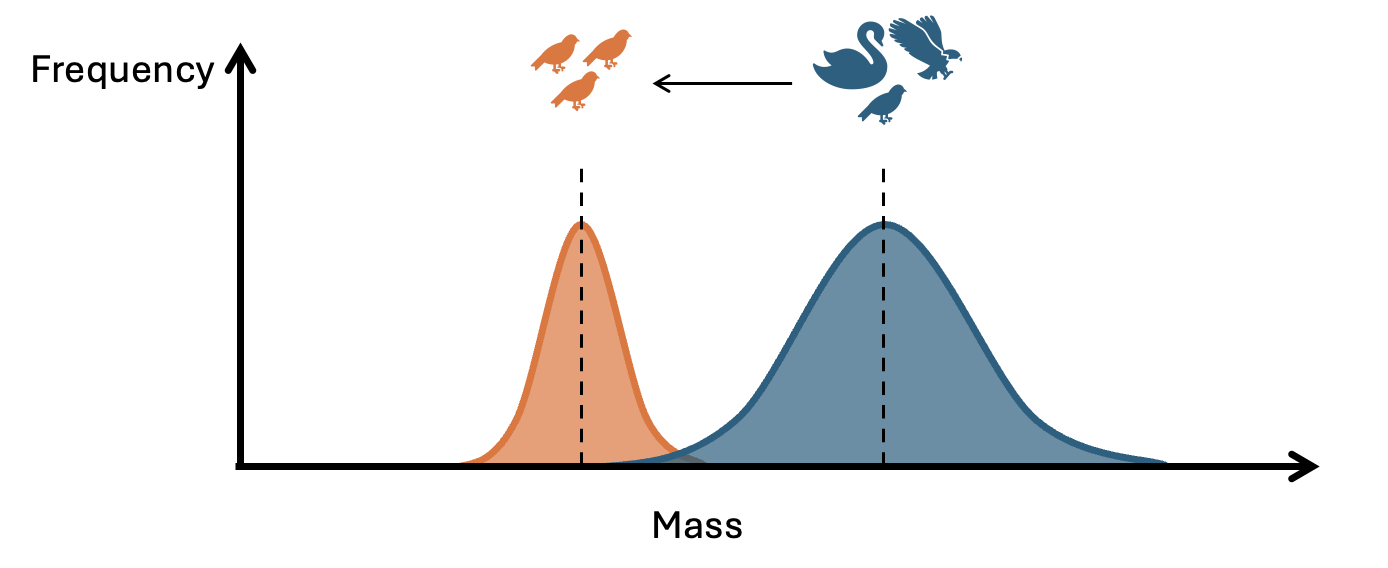
Under rapid global changes, certain species may be favored or disadvantaged, leading to changes in the functional composition of communities. Using 50 years of bird abundance data in North America, we found shifts in both the mean (community-weighted mean) and spread (community-weighted variance) of several key functional traits in local communities. Using a novel method, we found that these changes can be mostly attributed to a few species that have extreme trait values, or have dramatic changes in relative abundances. These species often respond positively or negatively to known environmental changes, especially human-induced land use changes. We provide a more mechanistic explanation on widely characterized changes in functional diversity among bird communities.
This is an ongoing project with Kai Zhu (University of Michigan) and Brian Weeks (University of Michigan). Stay tuned!