Complex communities in nature often contain interactions beyond pairwise (i.e., higher-order interactions). While common, little is known about how they change with the timing of species during community assembly. In nature, the time-dependence of interaction modifications could arise from plant-soil feedback: the different phenology of plants may affect the composition of soil microbiomes and subsequently their effects on other plants. With Xinyi Yan (University of Texas, Austin) and Volker Rudolf (Rice University), we first develop a quantitative framework of time-dependent interaction modification, then apply this framework to data generated by a novel mechanistic plant-soil feedback model. We find strong time-dependent interaction modifications when the soil microbiomes of all plants in the community greatly overlaps, which can arise from plants sharing pathogens or mutualists in nature. Our findings highlight the need to consider time in complex communities.
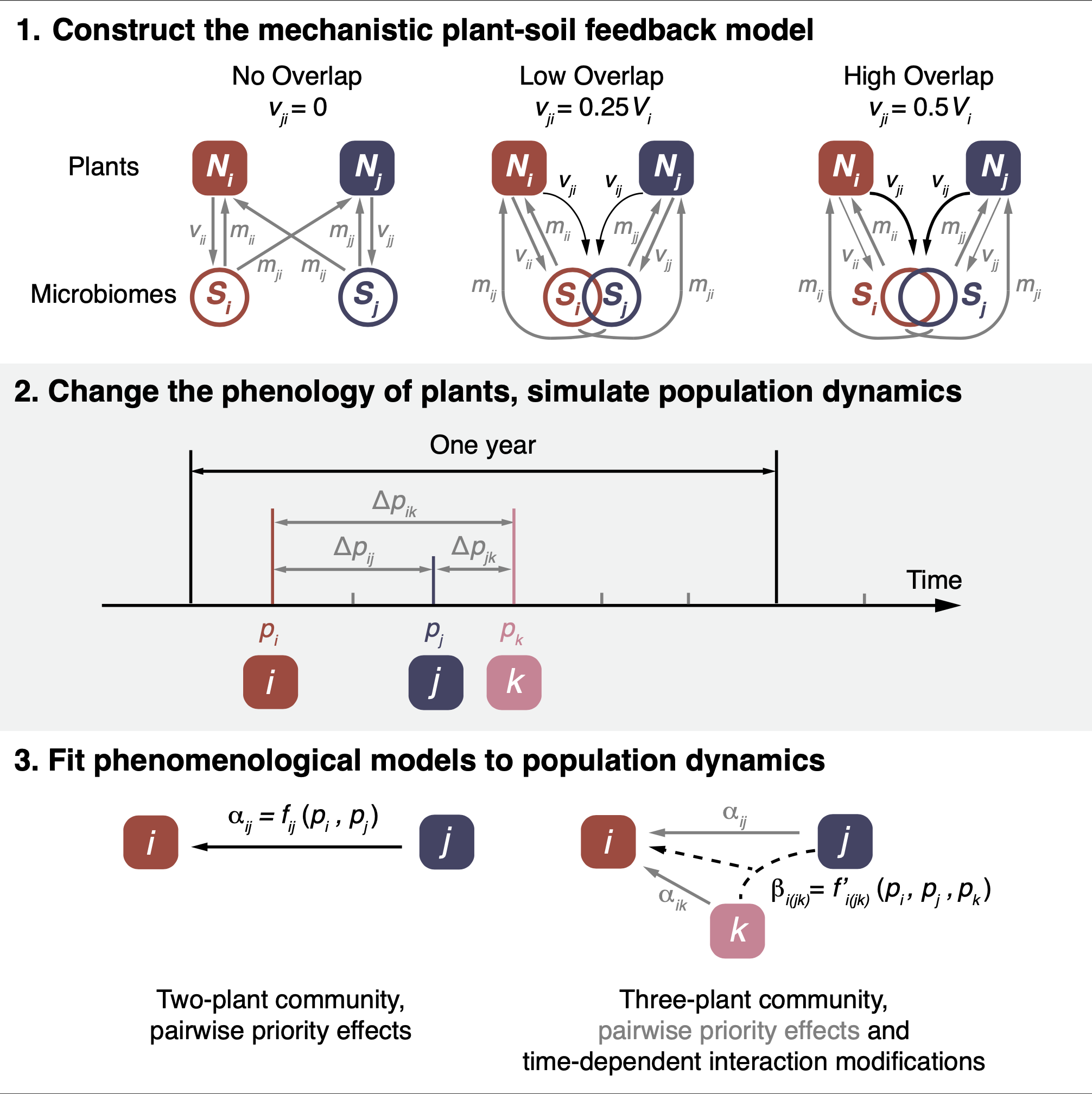
Time-dependent interaction modification from plant-soil feedback
A novel plant-soil feedback model reveals higher-order interactions that change through plant phenology
Theory
Plant
Phenology
Plant-soil feedback
First-author
Published in Ecology Letters, 2024
Keywords
community assembly, plant-soil feedback, higher-order interactions, phenology