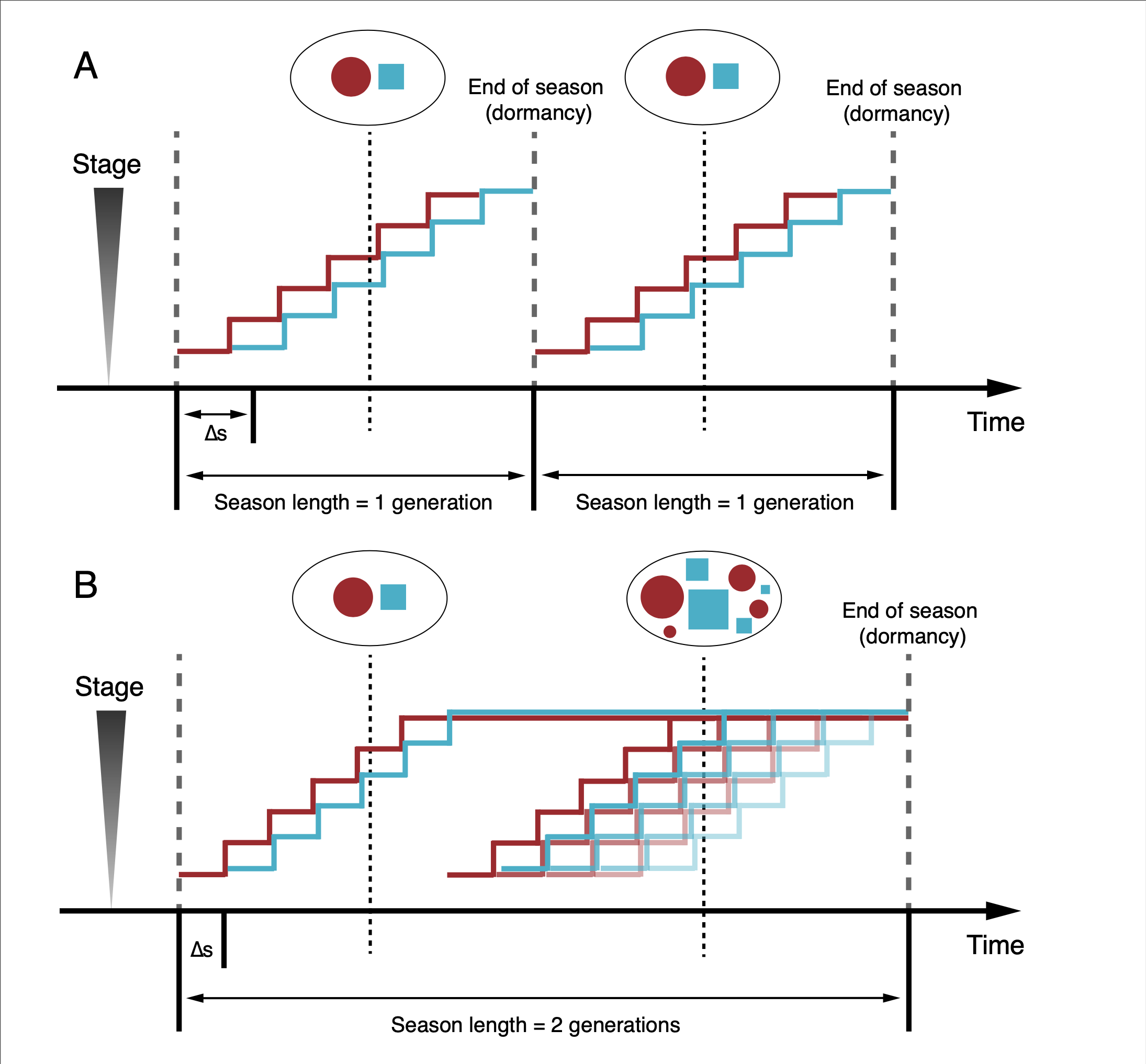
The role of priority effects in shaping the long-term dynamics of seasonal communities is poorly resolved. With Sebastian Schreiber (University of California, Davis) and Volker Rudolf (Rice University), we use a general stage-structured competition model to determine how different mechanisms of priority effects may influence the long-term competition outcomes in seasonal systems. Specifically, we assume that the strength of interspecific competition depends on the stage of both species. This mechanism generates “stage-mediated priority effects” that strongly affect long-term competition outcomes with fewer generations per growing season, but these priority effects diminish when each season consists of more generations. Our model reveals a novel link between the number of generations in a season and the consequences of priority effects, suggesting that consequences of phenological shifts driven by climate change should depend on specific life histories of organisms.
We later tested the results from this model in an experimental system of two competing Tribolium beetles.